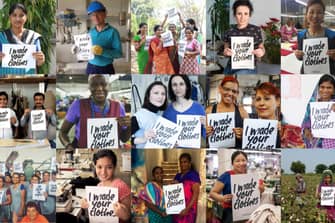

In the heady world of fashion, cotton is the most commonly used fabric and in agricultural terms accounts for 10% of world agriculture. So far so good - until you take on board that to turn these natural fibers into items of must-have clothing conventional cotton farmers use pesticides, herbicides and chemical fertilizers (approximately 25% of world pesticides) to make clothing. These pesticides are directly derived from World War 2 nerve gases, if you didn't know. The situation of cotton agriculture in the developing world, involving 400 million farmers, is without exaggeration, catastrophic.
Pesticides cause 20,000 deaths per year from accidental poisoning. 1 million long-term acute poisonings per year, 200,000 suicides per year (due to debt for pesticides). PAN estimates the real figures are much higher: upwards of a million deaths and three million long term poisonings. Most deaths occur in the developing world where there are few to no doctors, let alone hospitals.
Conventional cotton agriculture is additionally responsible for colossal greenhouse gas emissions due to chemical fertilizers, desertification and long-term contamination of the water supply.
Cotton is a very important export crop for many African and developing countries. In Mali, for instance, it is the second largest export by value after gold. In theory it is an excellent cash crop bringing in lots of foreign currency and providing a livelihood for the 10 to 11 million farmers across Africa involved, giving them enough money to feed themselves, school their children, and afford healthcare. This is totally possible but unfortunately it is not the case right now.
To grow cotton, before planting, farmers need a contract with the brokers to buy their cotton when it's harvested. As part of the contract they have to agree to buy the seeds and the pesticides from the broker. If they don't have the money the brokers have set up banks that will lend them the money to buy the pesticides, at 10% interest. The loan must be repaid within a year: if they can't repay the loan because their crop fails due to lack of rain, the banks foreclose and take their tools and bicycles, leaving them to continue farming. They leave their land for the cities, sending a little money home, and on their occasional returns to their villages often bringing HIV with them as well.
Developing world farmers are given virtually no information on the dangers of the pesticides - often banned in Europe and the US - which they are sold, including the need to wear protective clothing. The pesticides are often changed without notice. For example, in four West African countries the pesticides being used were recently changed from a parathyroid to an organochlorine (endosulfan) because of the problems with pest resistance, without any warnings to the farmers of the increased toxicity of the new chemicals. Nearly 100 people are known to have died in just one region in the last two seasons as a result of this, with over 220 serious poisonings.
Cotton prices are at a low not seen since the depression of the 1930s due to US, EU and Chinese cotton subsidies. Unless developing world farmers can farm cotton organically they can't make a living from it and will be forced to abandon cotton farming altogether.
If farmers grow cotton organically they increase their revenue 50% because of a 40% drop in the cost of inputs (fertilizers and pesticides), and a 20% premium for organic cotton.
The fashion industry as a whole is too lazy, too ignorant and too disinterested in fair trade and the environmental issues surrounding its sourcing of raw materials and manufacturing. It makes too much money from the low cost of outsourced cheap labour to be interested in making a change. Only pressure from the consumer in the form of boycott of unacceptable materials and manufacturing processes can make it change.
The industry is unwilling to change the way it works. People say that organic cotton will be too expensive, but the truth is that the value to the farmer of the cotton in a t-shirt is 4-5% of the retail value, so if he gets 20% more it puts 1% on the price of a t-shirt. This is hardly a prohibitive in cost, and it can make the difference between survival and the extinction of eleven million farmers in Africa and a further 90 million farmers in the rest of the developing world.
People ask, "Can ethical and environmental clothing become as popular as organic food?" - Why not? 75% of Marks & Spencer´s 15 million customers have ethical and environmental concerns when purchasing [source: M&S]. It may be a lot easier to care about people you love than have concern for people of a different culture who live 3,000 miles away, but it needs to be even more popular and firmly entrenched in the mainstream, as the issues it deals with, affect our global environment and economies, the health of 100 million farmers, our rivers, eco systems, seas, climate change, and the lives of a sixth of the world´s population.
By insisting on organic cotton and fair pay for garment workers and by paying 1% more for a t-shirt, you can change the world and make it a better and safer place.
www.katharinehamnett.com
22 March 2006
UK fabric shows at same venue
British fabric sourcing events ‘Start in London', ‘Intertex London' and the ‘New Elite Fabric Show' are to run simultaneously at the same location. This will offer buyers, distributors, agents and designers the opportunity to view a large, global offer of fabrics and accessories from 28 February to 1 March in London's Olympia 2.
Start in London offers woven and knitted fabrics from mills in Italy, France, Germany and the UK for the fashion industry.
Intertex London differentiates itself with the finest international fabric producers for women's, men's and children's wear. Fabrics range from cotton, linen, denim, silk, woven and knitted fabrics, laces, embroideries and fashion accessories and yarns.
Meanwhile, the New Elite Fabric Show offers products from mills farther a field such as Turkey, India, China and other countries in the Far East.
15 February 2006
The future of cashmere
Cashmere's luxury status is in peril, said executives who gathered in Prato, Italy, last month for a convention to discuss the challenges facing the sector.
The conference, organized by the Cashmere & Camel Hair Manufacturer's Institute and the Prato Industrial Union, focused on some of the key issues threatening production of the precious fiber, including raw cashmere being mixed with wool to meet increased demand, crossbreeding of the cashmere goat and misleading garment labeling.
"The main problem we have is keeping cashmere as a true luxury and investment product, and not letting it lose its quality or image, and be compromised through cheating on fiber or downgrading the quality," said Karl Spilhaus, CCMI president.
Italy's textile and clothing industry has a particular interest in the cashmere industry, as it imports 35 to 40 percent of the world's greasy cashmere — equivalent to 3.4 million kilos in 2004. Italy exported 1.8 million articles of cashmere pullovers, cardigans and other knitted items in 2004, with a value of 122.6 million euros.
Spilhaus said CCMI was trying to implement global regulations to measure cashmere fiber quality, in addition to keeping a closer eye on the cashmere supply chain, particularly in China.
"It's very hard to have real controls in China and there is a degradation of supply," said Spilhaus. "So, to meet demand, some cashmere is being mixed with sheep's wool. The goat-breeding techniques are also coming into question as they are now being crossbred with other types of goat, so the hair that is being produced is not as fine. The result is a watered-down cashmere."
Cashmere finished-product manufacturing also faces an increasing problem with counterfeiting or mislabeling of cashmere garments. CCMI is lobbying the U.S. and European governments to take action against people or companies who mislabel cashmere garments, while some pushed for an organization to safeguard the industry.
Correct garment labeling was particularly resonant to the Italian textile and clothing industry because Italy was one of the world's most important cashmere producers, said Carlo Longo, Prato Industrial Union president.
"The main problem facing the Italian textile and yarn industry today is counterfeiting, both in product and in a product's label," said Longo. "Merchandise comes in through the borders and it is not being checked, so products that tout cashmere content aren't being confirmed or approved in any way."
Longo said the industrial union would be asking European and Italian customs for more stringent checks on imports.
Most of Italy's cashmere is produced in the northern Biella region, along with superfine wool, but the Prato area, historically known for carded wool weaving, has begun to add more cashmere to its fabric compositions, said Longo.
7 December 2005
Lack Of Interest Postpones Elite Fabric Show
The revived Elite Fabric Show is postponing its debut until September as the response from potential exhibitors has been unsatisfactory. Pegasus Trade Communication which sought to bring back the show after a two-year absence said it had been too late in organising the event and now hopes to attract enough exhibitors for September. Exact dates will be confirmed next month.
16 February 2004